Automatic Sliding Gates on the Central Coast
A sliding gate is usually the answer when a driveway falls toward the street, the house sits close to the boundary, or there is simply nowhere for a swing leaf to go. The catch is that it needs a straight, level run beside the opening, and that is what an installer will look at first.
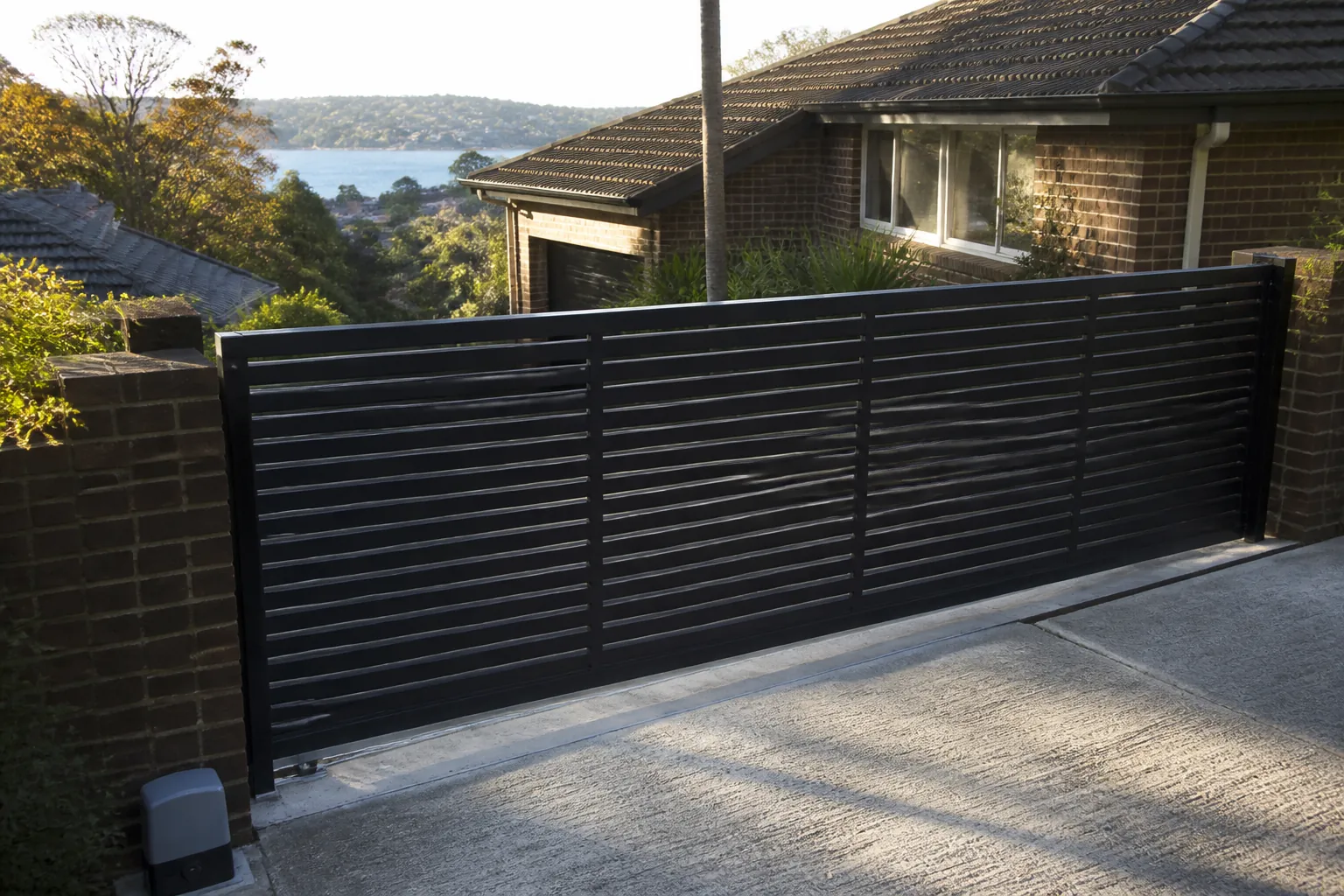
When a sliding gate makes sense
Sliding gates move parallel to the fence line, so they need no room in front of or behind the opening. That makes them the usual choice on the Central Coast in three situations:
- The driveway slopes up or down from the street, which is common on the escarpment streets above Gosford, Terrigal and Wamberal.
- The setback is short and a swing leaf would hit a parked car or block the path to the front door.
- The opening is wide and a pair of swing leaves would be heavy, slow and exposed to wind.
A swing gate on a slope has to clear rising ground through its whole arc. A sliding gate only needs the ground to be level along the line it travels, which is a much easier thing to build.
The run-back is the real constraint
A sliding gate needs a clear run beside the opening at least as long as the gate itself, plus room at one end for the motor. Before you get attached to a design, walk the fence line and look for anything in the way:
- Garden beds, letterboxes and meter boxes
- A retaining wall or a change in level partway along
- Trees whose roots will lift a track over time
- A neighbour's driveway or a boundary that bends
If the run is short, there are options. A telescopic gate uses two panels that stack, so it needs roughly half the run. A bi-parting slider splits the opening into two panels that move in opposite directions. Both cost more and add moving parts, so they are a fix for a genuine lack of space, not a default.
Tracks and ground conditions
Most residential sliders run on a steel track set into a concrete footing. How well that track lasts depends on what is underneath it. Sandy ground on the Woy Woy Peninsula and around The Entrance drains well but needs a properly sized footing so the track does not settle. Clay and sandstone around the Gosford ridges can crack a thin slab as it moves with wet and dry seasons.
Cantilever gates are worth asking about where a ground track is a problem. They hang from rollers mounted beside the opening and never touch the driveway, so there is nothing for leaves, sand or gravel to jam. They need a longer run-back and a stiffer frame.
Materials close to the beach
Properties within sight of the surf at Terrigal, Avoca, Copacabana or Shelly Beach see a lot more salt than homes in the valleys behind Erina or out toward Wyong. Powder coated aluminium is the common choice for coastal gates because it does not rust the way mild steel does, but the fixings, rollers and track still matter. Ask your installer what grade of stainless they use for fasteners and how they protect the motor housing from wind-blown spray. Our coastal corrosion guide covers this in more detail.
Motors and safety
Installers on the Central Coast commonly work with motor brands such as BFT, Centurion, ATA, DACE, Nice and FAAC. The right size depends on gate weight, length and how often it cycles in a day. A good installer will also fit obstruction sensing and photo-electric beams so the gate stops or reverses if something is in its path. The Australian standard for electric gate drives is AS/NZS 60335.2.103, and it is reasonable to ask whether the motor and installation are set up with it in mind.
Approvals and power
Under the NSW exempt development rules, a fence and gate on a road boundary generally needs to stay at or below 1.2 metres to avoid an application, and extra conditions apply on bush fire prone land. Anything taller or more complex may need approval from Central Coast Council. Any new power run to the gate is electrical wiring work, which in NSW must be done by a licensed electrician. If a power run is a problem, look at solar gate automation.
When you are ready, tell us about your driveway and we will pass your details to a local installer.
Why choose us for automatic sliding gates
- Suits sloping escarpment driveways where a swing gate would scrape
- Run-back, retaining walls and trees checked before a design is chosen
- Telescopic and cantilever options raised where space or ground is tight
- Coastal hardware questions asked up front for beachside homes
- Approvals and power runs flagged before you commit
Automatic Sliding Gates: common questions
How much room do I need beside the driveway for a sliding gate?
Roughly the width of the gate itself, plus space at one end for the motor. If that run is blocked by a wall, garden bed or tree, a telescopic or bi-parting gate can work in about half the space, at extra cost and complexity.
Will a sliding gate work on my steep driveway?
Usually yes, and it is often the better choice. The gate only needs a level line along the fence where it travels, not across the whole driveway. Your installer will check the levels along that line and how the footing will sit.
Do I need council approval for a sliding gate?
Many front gates fall within the NSW exempt development rules if they are no taller than 1.2 metres on a road boundary and meet the other conditions, which are stricter on bush fire prone land. Taller gates or unusual sites may need approval from Central Coast Council, so check before you build.
Tell us about your gate
Describe your driveway or the fault, and we will pass your details to an independent local installer who can arrange a site visit and quote.